Auxiliary (Intermediate ㊥ 11)
An auxiliary which expresses the speaker's judgment that someone/something should do something or should be in some state.
Equivalent: Should; ought to
| (i) Vinformal nonpast | べきだ | |
| 行くべきだ | Should go | |
| Exception | する→{す/する} べきだ | Should do |
| (ii) {Adjective な stem/Noun} | であるべきだ | |
| 積極的であるべきだ | Someone should be positive | |
| 目的であるべきだ | Something should be an objective |
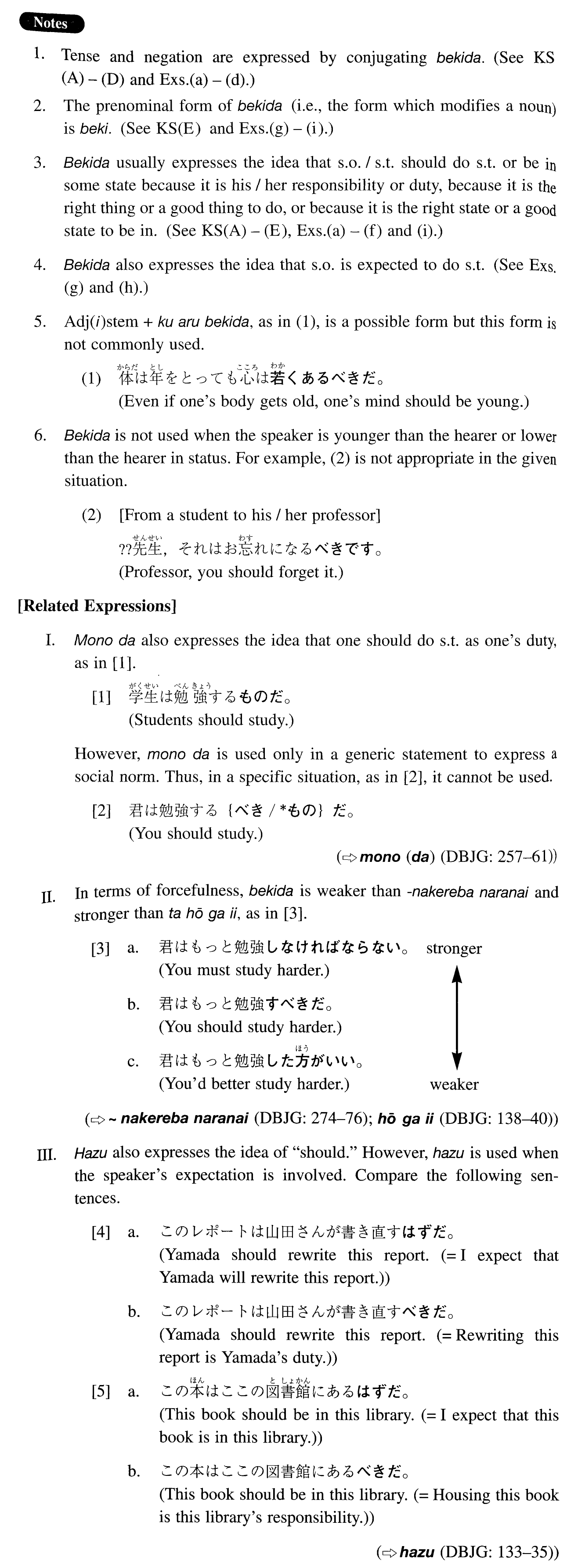
1. Tense and negation are expressed by conjugating べきだ. [See Key Sentences (A) - (D) and Examples (a) - (d).]
2. The prenominal form of べきだ (i.e., the form which modifies a noun) is べき. [See Key Sentence (E) and Examples (g) - (i).]
3. べきだ usually expresses the idea that someone/something should do something or be in some state because it is his/her responsibility or duty, because it is the right thing or a good thing to do, or because it is the right state or a good state to be in. [See Key Sentence (A) - (E), Examples (a) - (f) and (i).]
4. べきだ also expresses the idea that someone is expected to do s.t. [See Examples (g) and (h).]
5. Adjective い stem+くあるべきだ, as in (1), is a possible form but this form is not commonly used.
6. べきだ is not used when the speaker is younger than the hearer or lower than the hearer in status. For example, (2) is not appropriate in the given situation.
【Related Expressions】
I. ものだ also expresses the idea that one should do something as one's duty, as in [1].
[1]
However, ものだ is used only in a generic statement to express a social norm. Thus, in a specific situation, as in [2], it cannot be used.
[2]
(⇨ もの(だ)㊦)
II. In terms of forcefulness, べきだ is weaker than なければならない and stronger than たほうがいい, as in [3].
[3]
| a. | 君はもっと勉強しなければならな。 | stronger |
| You must study harder | ↑ | |
| b. | 君はもっと勉強すべきだ。 | | |
| You should study harder. | | | |
| c. | 君はもっと勉強した方がいい。 | ↓ |
| You'd better study harder. | weaker |
III. はず also expresses the idea of "should." However, はず is used when the speaker's expectation is involved. Compare the following sentences.
[4]
[5]
(⇨ はず㊦)